
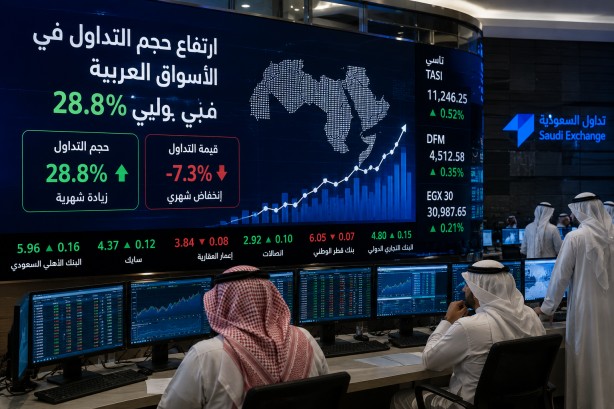
In July, trading activity across Arab stock markets experienced a notable surge, with the number of shares traded escalating by 28.82% from the previous month. This increase in trading volume, which reached 261.86 billion shares compared to 203.27 billion in June, was primarily fueled by a rise in activity on the Iraq Stock Exchange, followed closely by Egypt’s market.
While the volume of trades saw a significant uptick, the overall value of these transactions decreased. The total value fell by 16.82%, dropping to $90.24 billion in July from $108.48 billion in the previous month. This decline in transaction value was observed in several key markets, including Egypt, Saudi Arabia, Dubai, Abu Dhabi, and Kuwait, highlighting a trend of increased trading without a corresponding rise in transaction worth.
Despite the mixed performance observed across regional stock markets, Egypt’s EGX30 index stood out with a strong performance, registering a 5.85% gain over the month. Other regional exchanges also noted gains, though the results varied. The diverse outcomes among major Arab equity markets did not prevent the overall market capitalization of Arab stock exchanges from remaining relatively stable, with a slight increase of 0.06%, bringing it to approximately $4.31 trillion.
The figures presented for July underscore a complex economic landscape where trading activity has intensified, yet the value of those transactions has not kept pace. This dichotomy hints at shifting dynamics within regional markets, where increased participation does not necessarily translate into higher market valuations. The performance of individual exchanges and indices, such as Egypt’s EGX30, indicates that while some markets are thriving, others are experiencing more modest outcomes.