
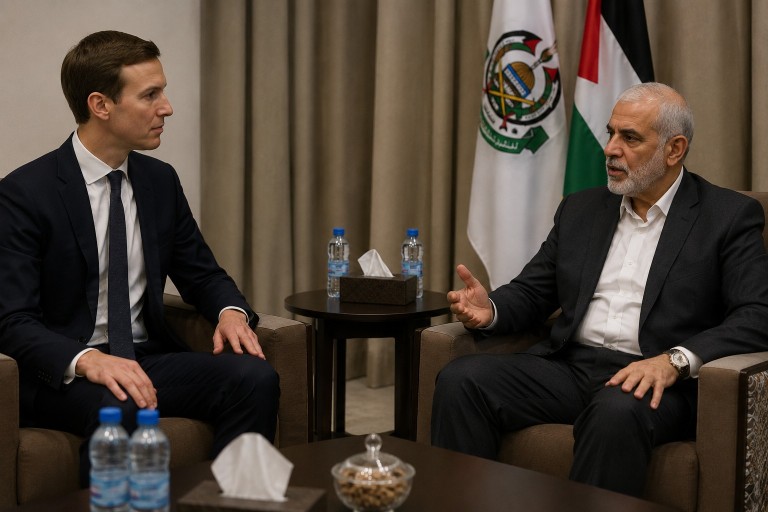
In a renewed diplomatic effort by the United States, Jared Kushner, adviser and envoy, engaged in talks with Khalil al-Hayya, the political chief of Hamas, in Egypt on Sunday. This meeting is part of a larger initiative to revive a stalled ceasefire plan for Gaza. Kushner’s diplomacy comes just before his scheduled discussions with Israeli Prime Minister Benjamin Netanyahu, who has recently dismissed a US-supported 15-point proposal for advancing the ceasefire process.
The proposed plan outlines a gradual disarmament of Hamas, coupled with a cessation of Israeli military operations and a withdrawal from specific areas in Gaza. Additionally, the roadmap includes reconstruction initiatives and the deployment of international forces to ensure security. However, Hamas has stated it is committed to the plan but insists on Israel halting attacks and withdrawing to the so-called “yellow line” as prerequisites for implementation. Furthermore, Hamas has tied disarmament of its heavier weaponry to advancements towards establishing a Palestinian state, a concept opposed by Netanyahu’s administration.
Netanyahu maintains that a complete withdrawal of Israeli forces from Gaza is contingent upon the complete disarmament of Hamas, stalling significant aspects of the ceasefire plan, such as reconstruction efforts and international force deployment. Kushner’s meeting with Hamas included representatives from Egypt, Qatar, and Turkey, and aimed to secure Hamas’s agreement to the disarmament aspect of the plan prior to his engagement with Netanyahu.
In addition to Netanyahu, Kushner is expected to meet with former British Prime Minister Tony Blair and Nikolay Mladenov, the Director of the Board of Peace. Meanwhile, countries like Saudi Arabia, the United Arab Emirates, Jordan, Pakistan, and Indonesia have voiced criticisms of Israel’s dismissal of the US-backed plan, urging immediate steps to prevent further delays.
This diplomatic initiative gains urgency as Netanyahu faces mounting political pressure ahead of Israel’s October election. His coalition government includes ministers advocating for a more stringent approach toward Gaza, casting uncertainty over the future of the ceasefire plan.